
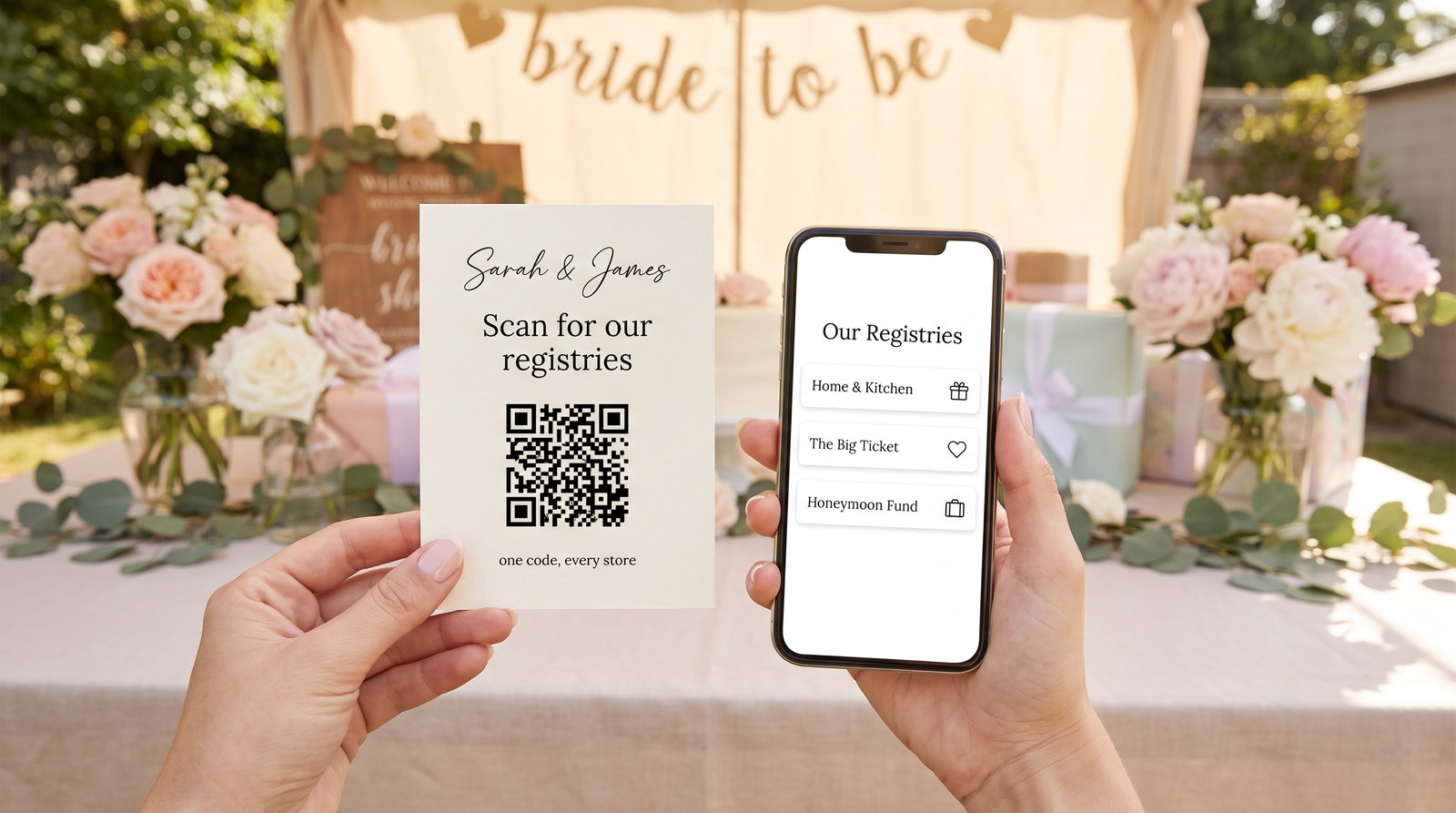
One code on the invites. Every registry behind it, changeable to the last minute.
Here is the problem a registry sets up. Your list is almost never in one place. There is an Amazon list, maybe a Target one, a store for the nice stuff, and a cash or honeymoon fund. And it moves the whole time: you add items, things get claimed, a store runs out, and after the day itself the registry stops mattering but the thank-you note does. Meanwhile the invitations are a single print run that went out weeks ago. A plain link or a static QR printed on the card is frozen at the moment it went to press, so the day anything changes, the card is pointing at the wrong thing.
What is the best QR code for a gift registry?
The best registry code is a dynamic QR code you buy once and can repoint whenever your list changes. Print it on the save-the-dates, the shower invites, and the wedding site, and if you add a store next month or switch to a honeymoon fund after the wedding, you update one destination and every card already in the mail keeps working. At Graklink that is a one-time $7.99, with no subscription and nothing that expires.
Make one code for every registry: start at graklink.com.
Can one QR code point to all my registries at once?
Yes, and it is the setup most couples actually want. Instead of listing three different store links on an invitation, where only one realistically fits, you point a single code at one simple page that holds all of them: Amazon here, Target there, the cash fund at the bottom. A guest scans once and picks where to shop.
Because the code is dynamic, that page is yours to change for as long as you like. Add a registry the week of the shower, take one down when it is fully claimed, or retire the whole list and swap in a thank-you note after the wedding. The printed invite never knew the difference. One code, every store, editable to the last minute.
Pick your registry code and point it at everything at once.
Should a registry QR code be static or dynamic?
A registry changes and the invites do not, so the code has to be the kind you can edit. That is the entire decision.
A static QR code bakes the destination into the pattern. It is free and it never expires, but it can never be changed, so the day you add a store or the wedding ends, the printed code is wrong and there is nothing to do about it. A dynamic code points at a short redirect you own, so you can send it anywhere and change where it goes from your phone, without reprinting a thing. If you want the full difference, we lay it out in static vs dynamic QR codes and in what an editable QR code actually is.
| Static code | Dynamic code (Graklink) | |
|---|---|---|
| Cost | Free | $7.99 once |
| Change the destination after printing | No | Yes, anytime |
| Point at several registries at once | Only if the target page never changes | Yes, and edit the list anytime |
| Reuse it after the event | No | Yes, repoint to a thank-you page |
| Expires or needs a subscription | No / No | No / No |
For a registry, dynamic is the honest choice, because the one thing you can count on across an engagement or a pregnancy is that the list will change.
Where should a registry QR code point?
Because the code is dynamic, one printed square can go almost anywhere, and you can move it as the plans change. The destinations that earn their place on an invite:
- A single “all our registries” page. The strongest default: one link that lists every store and fund, so guests choose in one place. Many wedding-site builders give you a page like this for free, and the code can point straight at it.
- Your wedding or event website. If you already have one, send people there and let the registry live as a tab alongside the schedule and directions.
- One specific registry. For a smaller shower with a single list, point the code straight at that store.
- A cash or honeymoon fund. Increasingly the main event. Point the code at the fund, then repoint it to a thank-you page once the gifts are in.
One printed code carries the whole gift side of your event, and where it goes stays yours to change.
What does a registry QR code cost?
A dynamic Graklink registry code is $7.99 once with no subscription, which is the part that fits a one-time event. A gift registry is used hard for a season and then almost never again, so paying a service every year to keep the code alive makes no sense for it. Buy the code once, use it through the showers and the wedding and the thank-you notes, and let it sit harmlessly afterward without a renewal bill.
If you want a mark or a color on the code to match your invitation suite, a custom design is a one-time $4.99. If you are running a big event and want several codes (one for the couple, one for a shower host, one for the registry table), bulk pricing is $5.99 each for 2 to 9, with the design charged once. Nothing here renews, because a wedding invitation should not come with a subscription.
Buy your code once and skip the yearly bill for a one-time celebration.
Make sure it scans before you print the invitations
Invitation designs fight QR codes: pale palettes, gold foil, script type, tight margins. A code that looks lovely on the layout can be unscannable on the printed card. Before the full set goes to the printer, run this list:
- Strong contrast. The code needs to be clearly darker than the paper. Gold-on-cream or white-on-blush can fail; test anything low-contrast.
- A clear quiet zone. Leave an empty margin on all four sides. Do not let a flourish, a monogram, or the card edge crowd it.
- Enough size. At least about 0.8 inch (2 cm) square. Give it room rather than shrinking it to tuck into the design.
- Then scan it. On more than one phone, from the actual printed proof, before you order the whole run.
The full breakdown of why codes fail, with examples, is in our guide: why QR codes don’t scan, and the measurements you actually need for an invitation are in how big a QR code should be for print. Planning the rest of the day too? Our wedding QR guide covers the website, seating, and photo-sharing codes alongside the registry.
Sources
- Graklink pricing and policy. Verified against the repo canonical pricing (marketing/README.md), 2026-07-22.
Your invitations ship once. Your registry changes until the day itself. Make a code that keeps up at graklink.com.
Make yours now
Point it anywhere. Change it anytime. Print it forever. $7.99, once.
Your website, menu, listing, anything on the web.
Customize the look
Personalize your address from $1.99
Leave blank for a free random address.
Choose your analyticschoose one
Free for 30 days, then auto-renews; cancel anytime. Your codes keep working either way.
✓ Scan-checked: strong contrast, reads at print size
solidqr.co/•••••
One payment, one time,
scans forever.

30 day money back guarantee

Questions gift registries actually ask
What should a gift-registry QR code link to?
The most useful target is a single page that lists all your registries at once: your Amazon list, your Target list, a store or two, and a cash or honeymoon fund. Guests scan one code and pick where to shop, instead of you cramming three links onto an invite. Because the code is dynamic, you can add or remove a registry on that page anytime without touching the printed invites.
Can I add registries after the invites are printed?
Yes, and that is the whole point of a dynamic code. The code on the invite points at a destination you control, so you can add a new store, swap in a honeymoon fund, or mark something as fully claimed, and every printed invite reflects the change instantly. A static QR baked onto the card could never do that.
Do I have to pay a subscription to keep a registry code working?
No. It is $7.99 once, with no subscription. A printed Graklink code never stops redirecting because of a billing event. The only two things that can ever stop a code are an acceptable-use violation (phishing, malware, fraud, illegal content) or you deleting your own account. Never money, which matters for something you use for one season and then rarely again.
What happens to the code after the wedding or shower is over?
It keeps working, and you can repurpose it. Point the same code at a thank-you page, a photo gallery, or a note about where the honeymoon fund went. Guests who scan an old invite months later still land somewhere real instead of on a dead link, and you never paid a renewal to keep it alive.
How big should the QR code be on an invitation?
Keep it at least about 0.8 inch (2 cm) square, with a clear empty margin around it, and darker than the paper behind it. Invitations often use pale colors and script fonts, so give the code contrast and room rather than shrinking it to match the design. Scan your proof on a couple of phones before you print the full set.
Is a QR code better than just writing the registry link on the invite?
For a printed invite, usually yes. A typed link like a long store URL or a wedding-site address is easy to mistype and annoying to enter by hand. A scan opens it in one tap. And a single QR code can hold all your registries at once, where a printed line of text realistically fits only one.